
Guide
Effexor (Venlafaxine) Withdrawal: Why It Starts Within a Day, How Long It Lasts, and What Actually Stops It
Joint Commission accredited · In network with most major insurance · Admissions answered 24 hours a day

Published September 27, 2026
Effexor is the antidepressant people most often describe missing by a single dose: dizziness by the afternoon, “brain zaps” by evening, and a flu they cannot explain the next day. That is not imagination and it is not addiction. It is the pharmacology of a drug that leaves the body in about a day, and it has been measured in trials, labels and a 2024 meta-analysis of 21,002 patients. This page gives the timeline, the reason venlafaxine is worse than most antidepressants for this, what stops the symptoms, how to tell them from a return of depression, and where a detox center does and does not fit.
How long does Effexor withdrawal last?
Effexor withdrawal begins within hours to three days of a missed or stopped dose and, for most people, is mild and resolves within one to two weeks. A minority have symptoms that persist for weeks longer, especially after stopping abruptly from a high dose.
The American Academy of Family Physicians’ review of antidepressant discontinuation syndrome gives the shape: symptoms typically appear within three days of stopping or starting a taper, have been reported within hours of the first missed dose, are usually mild, and resolve on their own in one to two weeks. A systematic review of withdrawal after stopping serotonin-norepinephrine reuptake inhibitors, the class venlafaxine belongs to, found symptoms typically beginning within a few days and lasting a few weeks even with gradual tapering, with late onset and longer persistence in some people.
The manufacturer’s label adds that the frequency rises with higher doses and longer treatment. The Prozac comparison further down explains why fluoxetine, at the other end of the half-life scale, rarely does this.
Source: Antidepressant Discontinuation Syndrome, Warner et al., American Family Physician, 2006.
Why is Effexor withdrawal worse than most antidepressants?
Effexor withdrawal is worse because venlafaxine has an elimination half-life of about 5 hours and its active metabolite about 11 hours, so blood levels fall within a day of a missed dose. Discontinuation symptoms are most common with the shortest-acting antidepressants.
The Effexor XR prescribing information gives the numbers: an apparent elimination half-life of 5 plus or minus 2 hours for venlafaxine and 11 plus or minus 2 hours for its active metabolite, with about 87 percent of a dose recovered in the urine within 48 hours. The extended-release capsule slows absorption, not elimination, so once the last capsule has released, the clock is the same. Compare fluoxetine, whose half-life is measured in days and which the family physicians’ review notes produces discontinuation symptoms far less often; the same review’s table lists venlafaxine’s half-life at 3 to 13 hours.
The 2024 Lancet Psychiatry meta-analysis confirms where venlafaxine sits. Across 79 studies, desvenlafaxine, venlafaxine, imipramine and escitalopram were associated with higher frequencies of discontinuation symptoms, and venlafaxine or desvenlafaxine, along with imipramine and paroxetine, with higher severity. The systematic review of SNRI withdrawal found the prevalence higher with venlafaxine than with other drugs in its class.
Source: EFFEXOR XR (venlafaxine hydrochloride) prescribing information, DailyMed, National Library of Medicine; Incidence of antidepressant discontinuation symptoms: a systematic review and meta-analysis, Henssler et al., Lancet Psychiatry, 2024.
What are the symptoms of Effexor withdrawal?
Effexor withdrawal produces dizziness, nausea, flu-like symptoms, insomnia, imbalance, “electric shock” sensations in the head, and irritability or anxiety. Clinicians remember them with the mnemonic FINISH: flu-like symptoms, insomnia, nausea, imbalance, sensory disturbances, hyperarousal.
The label’s own list, from systematic evaluation in venlafaxine trials, runs longer: agitation, loss of appetite, anxiety, confusion, impaired coordination and balance, diarrhea, dizziness, dry mouth, low mood, muscle twitching, fatigue, flu-like symptoms, headache, hypomania, insomnia, nausea, nervousness, nightmares, sensory disturbances including electric-shock sensations, sleepiness, sweating, tremor, vertigo and vomiting. Post-marketing reports after abrupt discontinuation add irritability, lethargy, emotional lability, ringing in the ears and, rarely, seizures.
The brain zaps deserve their own sentence because they frighten people. They are brief electric-shock or rushing sensations in the head, often set off by moving the eyes, and the family physicians’ review lists them among the symptoms that distinguish discontinuation from a relapse of depression. They are unpleasant and not dangerous, and they stop when the drug is restarted.
Where we are
Detox centers across Texas
Three locations, each with its own admissions line and its own clinical team. Pick the one nearest you — or call and we will tell you which has a bed tonight.
-
 Inpatient
 Austin, TX
11711 N Lamar Blvd · 78753
- 15 beds
- On-site labs
- 24-hour medical staff
Drug & Alcohol Detox in Austin, TX
-
 Inpatient
 Houston, TX
1019 Ashland St · 77008
- On-site labs
- 24-hour medical staff
Drug Detox Center in Houston, TX
-
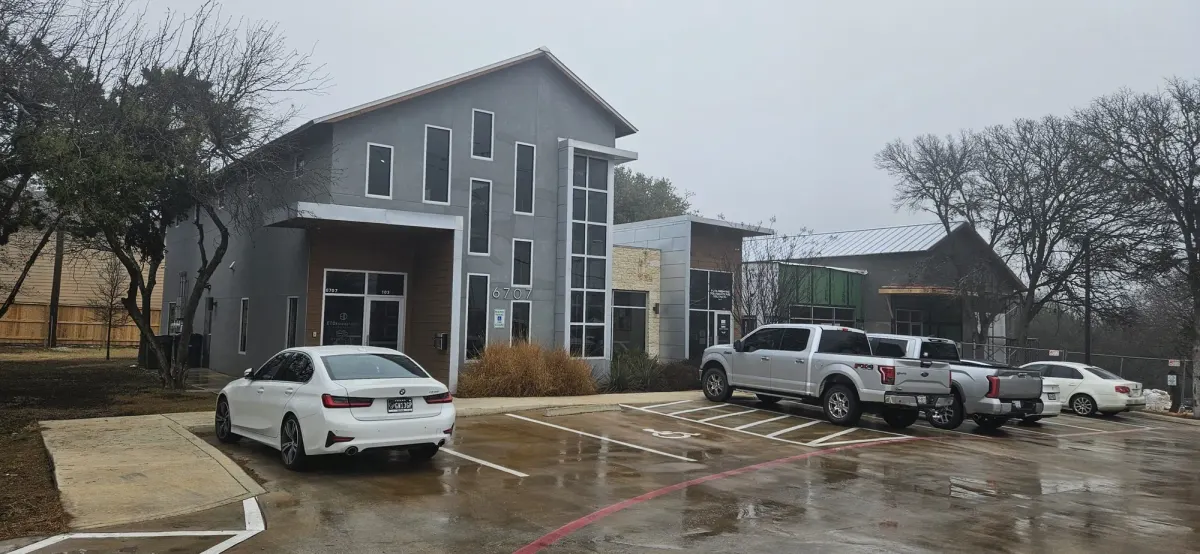 Outpatient
 San Antonio, TX
6707 W Hausman Rd · 78249
- Outpatient detox with scheduled medical visits
- Outpatient treatment
Outpatient Drug & Alcohol Detox in San Antonio
How long does Effexor stay in your system?
Effexor is essentially gone from your system within about a day of the last dose, and its active metabolite within two to three days, which is why withdrawal arrives so fast.
Pharmacology’s rule of thumb is that a drug is effectively eliminated after about five half-lives. At 5 hours for venlafaxine that is roughly a day; at 11 hours for the metabolite, roughly two to three days. The label’s figure that 87 percent of a dose is in the urine within 48 hours says the same thing from the other direction.
Two practical consequences follow. First, a missed evening dose of the immediate-release tablet can produce symptoms by the next morning, and a missed extended-release capsule by the day after. Second, the symptoms of the first days are withdrawal, not the return of depression, because the illness does not come back in 24 hours; the review notes that a depressive relapse takes far longer to develop and does not reverse in a day when the drug is restarted.
What is the Effexor withdrawal timeline?
Effexor withdrawal symptoms start within hours to three days of the last dose and are at their worst over the first several days. They ease over one to two weeks and in a minority of people persist for weeks longer.
That is as precise as the evidence allows, and the earlier version of this page claimed more precision than exists. The family physicians’ review reports, for short-acting antidepressants in general, a mean onset of two days and a mean duration of five days in one study, and a resolution within one to two weeks overall.
The SNRI review reports onset within a few days and a duration of a few weeks even with tapering, and notes both late onset and longer persistence in some cases. Nothing in those sources fixes a peak day. What they agree on is that the course is short for most people and that the way to shorten it further is to restart and taper, covered below.
Source: Withdrawal Symptoms after Serotonin-Noradrenaline Reuptake Inhibitor Discontinuation: Systematic Review, Fava et al., Psychotherapy and Psychosomatics, 2018.
How common is Effexor withdrawal?
About one in six or seven people who stop an antidepressant have withdrawal symptoms attributable to the drug, and roughly 3 percent have severe symptoms. Venlafaxine is among the antidepressants with the highest frequency and severity.
The Lancet Psychiatry meta-analysis is the best estimate available. Across 21,002 patients, 31 percent reported at least one discontinuation symptom after stopping an antidepressant, against 17 percent after stopping a placebo, which the authors read as an incidence of about 15 percent attributable to the medication itself, with severe symptoms in 2.8 percent versus 0.6 percent on placebo. The family physicians’ review, working from older trials, put the figure at about 20 percent after abrupt discontinuation of a drug taken for at least six weeks, and notes that reactions are rare in people who have taken an antidepressant for less than six to eight weeks. Both figures are averages across all antidepressants; venlafaxine’s are higher.
What stops Effexor withdrawal?
Restarting the previous dose stops Effexor withdrawal, usually within a day and almost always within three. The dose is then reduced again more slowly; the label’s trial taper was 75 milligrams a week, and some people need several months.
The prescribing information is specific. A gradual reduction rather than abrupt cessation is recommended; in the clinical studies tapering was done by reducing the daily dose by 75 milligrams at one-week intervals; individualization may be necessary; and if intolerable symptoms follow a dose decrease, resuming the previously prescribed dose may be considered, then decreasing again at a more gradual rate, in some patients over several months.
The family physicians’ review says severe symptoms should resolve in fewer than three days, and often within 24 hours, of restarting, and that supervised tapering over six to eight weeks may be needed to minimize symptoms. The National Library of Medicine’s instruction to patients is the plain version: do not stop taking venlafaxine without talking to your doctor, who will probably decrease the dose gradually.
Two cautions from the same sources. Generic formulations are allowed up to a 20 percent difference in bioavailability, so a switch between manufacturers can produce an unintended drop and a burst of symptoms. And a person who has been off the drug for weeks is not in withdrawal any more; what they have is whatever the drug was treating, and that is a different conversation with the prescriber.
Source: Venlafaxine, MedlinePlus Drug Information, National Library of Medicine.
Is Effexor withdrawal dangerous, and is it a detox matter?
Effexor withdrawal is not life-threatening in the way alcohol or benzodiazepine withdrawal is, and it is not a reason for medical detox on its own; it is a prescriber’s taper. It becomes Briarwood’s concern when it arrives alongside a detox for something else.
The family physicians’ review describes the syndrome as reversible, not serious or life-threatening, and self-limiting within one to two weeks, with immediate psychiatric consultation reserved for the rare cases involving psychosis, catatonia or severe cognitive impairment. Two things are worth watching regardless: the label’s post-marketing reports of seizures after abrupt discontinuation, and the National Library of Medicine’s warning that any change in an antidepressant calls for watching for new or worsening depression and thoughts of self-harm. Neither is a reason to stop a medication without a plan, and both are reasons to have one.
Briarwood does not run a detox program for venlafaxine alone. The earlier version of this page implied that it might, and the honest statement is that stopping an antidepressant is managed by the prescriber who started it, with the taper the label describes.
Where Briarwood does come in is the overlap. A large share of people admitted for alcohol, benzodiazepine or opioid detox are on an antidepressant, and some have stopped it, deliberately or by running out, in the chaos of the weeks before admission.
The medical assessment on the first day asks about every prescribed medication for exactly this reason: an antidepressant is continued through the stay rather than dropped, a person in discontinuation symptoms is restarted, and someone who wants to come off it later is referred to a prescriber for a proper taper after detox. The prescription drug detox page describes which medications Briarwood does detox and how. Admissions is answered at every hour, and if the question is whether what you are feeling is Effexor withdrawal or something a detox center should see, the first call can usually tell you which.
Common Questions
How long does Effexor withdrawal last?+–
For most people, one to two weeks, starting within hours to three days of the last dose. A minority, especially after stopping abruptly from a high dose, have symptoms for weeks longer.
Why do I get withdrawal from missing one dose of Effexor?+–
Venlafaxine's half-life is about 5 hours and its active metabolite's about 11, so blood levels fall within a day of a missed dose. Antidepressants with short half-lives produce discontinuation symptoms far more often than long-acting ones such as fluoxetine.
What are Effexor brain zaps?+–
Brief electric-shock or rushing sensations in the head, often triggered by eye movement. They are a recognized discontinuation symptom, not dangerous, and they stop when the drug is restarted.
How do I stop Effexor withdrawal symptoms?+–
Restart the previous dose, which usually resolves symptoms within a day and almost always within three, then taper more slowly with the prescriber. The label's trial taper was 75 milligrams a week, and some people need several months.
Is Effexor addictive?+–
No. It produces physical dependence, meaning withdrawal symptoms on abrupt stopping, but not the craving or compulsive use that defines addiction. The withdrawal is a pharmacological effect of a short half-life, not a sign of misuse.
Does Briarwood detox people from Effexor?+–
Not from Effexor alone; stopping an antidepressant is a prescriber-managed taper. Briarwood manages antidepressants for people admitted for alcohol, benzodiazepine or opioid detox, restarts them when someone arrives in discontinuation symptoms, and refers to a prescriber for a taper afterward.
Related guides

About the people behind this guide
Anna-Grace Washington
Medical Content Writer
Anna-Grace Washington is a Medical Content Writer for Briarwood Detox Center. She holds a master’s degree in clinical psychology from the University of Texas and brings a strong understanding of behavioral health, addiction recovery, and evidence-based treatment concepts to her writing.
In network with most major insurance
Find your plan and see what detox would cost
Most plans cover medical detox. Coverage varies by plan, so we verify it for you before you commit to anything.



















Don't see your plan? We work with out-of-network benefits and offer self-pay options — (866) 710-7710
- Confidential
- Takes about 2 minutes
- No obligation to admit

- Accredited The Joint Commission
- Rated 4.7 · 183 Google reviews Flourishing Foundations Recovery, now part of Briarwood
- Admissions 24 hours a day