
Our programsWhat we treat
Benzodiazepine Detox: A Supervised Taper, Not an Abrupt Stop
Supervised benzodiazepine detox in Austin and Houston: a taper onto a long-acting drug, round-the-clock nursing, and the next step arranged before you leave.
Admissions answered 24 hours a day · Most major insurance accepted
Includes reviews of Flourishing Foundations Recovery, now part of Briarwood
The essentials
Benzodiazepine detox, in short
Supervised benzodiazepine detox in Austin and Houston: a taper onto a long-acting drug, round-the-clock nursing, and the next step arranged before you leave.
Not sure if you need detox?
A nurse can tell you in one call. Free, confidential, and answered around the clock.
At a glance
Texas · Medical detox
- What this is
- Medically supervised benzodiazepine detox
- Supervision
- Licensed medical staff on site, 24 hours a day
- Starts with
- A medical assessment, before anything is recommended
- Locations
- Austin · Houston · San Antonio
- Admissions
- (866) 710-7710 — answered 24 hours a day
- Insurance
- In network with most major carriers; benefits verified free
- After detox
- The next step is arranged before you leave
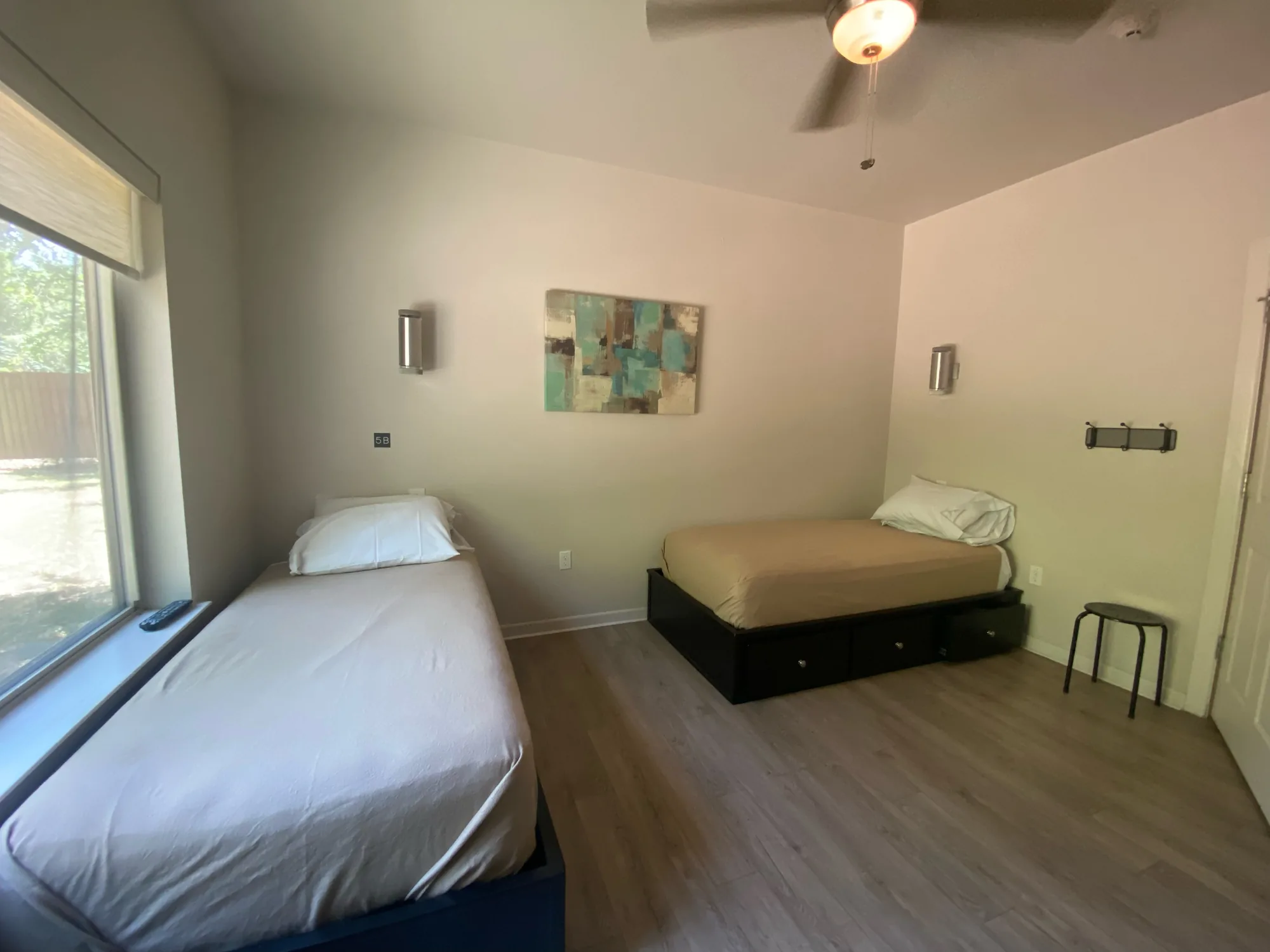
Before you arrive: what to expect from our detox covers the medical assessment, how long a stay usually runs, the privacy options and the rooms themselves.
Coverage
Our center is in-network with many insurances
Type your plan below to check it, or call and we will verify your benefits with your insurer directly. Free, and with no obligation to admit.



















Takes about two minutes · Or call (866) 710-7710

- Accredited The Joint Commission
- Rated 4.7 · 183 Google reviews Flourishing Foundations Recovery, now part of Briarwood
- Admissions 24 hours a day
Xanax, Klonopin, Ativan and Valium are among the most prescribed medications in the country, and stopping them is harder than starting them. Benzodiazepine withdrawal is one of two withdrawals that can be medically dangerous, and the way through it is a taper, not a stop. This page explains who needs medical detox for benzodiazepines, what happens during a stay at Briarwood in Austin or Houston, how long it takes, and what follows.
Do I need medical detox for benzodiazepines?
You need medical detox for benzodiazepines if you have taken them daily for more than a few weeks and cannot stop without symptoms, because the FDA warns that abrupt discontinuation can cause life-threatening seizures.
The Food and Drug Administration added a boxed warning to the entire benzodiazepine class in September 2020. It states that physical dependence can develop when the drugs are taken steadily for several days to weeks, even at prescribed doses, and that stopping abruptly or reducing the dose too quickly can produce withdrawal reactions, including seizures, that can be life-threatening. The federal detoxification protocol goes further: all benzodiazepines should be tapered rather than stopped abruptly, regardless of dose or duration, unless use has lasted only a few days.
Whether that taper happens with your prescriber or in a detox center depends on the dose, how long you have taken it, whether you have tried to stop before, and whether alcohol or opioids are also involved. A nurse can tell you which on the first call, and the answer is sometimes that a prescriber’s taper is enough. When it is not, this is what a stay involves.
Source: FDA requiring Boxed Warning updated to improve safe use of benzodiazepine drug class, U.S. Food and Drug Administration.
What happens during benzodiazepine detox at Briarwood?
Benzodiazepine detox at Briarwood is a medical assessment, a switch from your benzodiazepine to a longer-acting one or phenobarbital, and a monitored step-down over the stay, with nursing around the clock.
The assessment comes first: which benzodiazepine, how much, for how long, what else you take, what happened the last time you stopped, and what medical and psychiatric conditions are in the picture. From that, the medical team sets the protocol.
In most cases that means moving you from a short-acting drug onto a long-acting one at an equivalent dose, stabilizing there, and then reducing the dose in steps. Vital signs, sleep, anxiety and tremor are checked at intervals through the day and night, so a step that was too large is caught before it becomes a problem. Medication is given for the symptoms that come through: sleep, nausea, blood pressure, anxiety.
Alongside the medical work, a detox counselor meets with you individually and in group, and the clinical team begins arranging what comes after the stay, because a benzodiazepine taper that ends with no plan for the anxiety underneath it tends not to hold. The what to expect page covers the rooms, the daily routine and what to bring.
What are benzodiazepine withdrawal symptoms?
Benzodiazepine withdrawal symptoms are anxiety, insomnia, sweating, nausea, tremor and a racing heart, and in severe cases seizures, hallucinations and delirium, the reactions the FDA’s boxed warning lists.
The early symptoms look like the condition the drug was prescribed for, only sharper: panic, restlessness, irritability, and sleep that will not come. Physical symptoms follow, including shaking hands, sweating, palpitations, headache, nausea, muscle pain, and sensitivity to light and sound. The FDA lists the serious acute reactions as seizures, catatonia, delirium tremens, psychosis, mania, hallucinations, and suicidal thoughts and behavior. Most people do not experience those, and there is no reliable way to know in advance who will, which is the reason supervision exists. The Xanax withdrawal page covers the most common case in detail.
What is the benzodiazepine withdrawal timeline?
The benzodiazepine withdrawal timeline follows the drug’s half-life, so short-acting drugs such as Xanax begin within 6 to 8 hours and long-acting ones such as Valium in 1 to 4 days.
For a short-acting benzodiazepine such as Xanax or Ativan, symptoms can begin 6 to 8 hours after the last dose and usually fade within 10 to 14 days. For a long-acting one such as Valium, Librium or Klonopin, symptoms may not appear for 1 to 4 days, tend to peak around day 10 to 14, and can last up to four weeks. Insomnia and anxiety are the symptoms people find hardest, and they peak early.
Two things follow from that. A person on a long-acting benzodiazepine can feel fine on day two of detox and be at their worst on day ten, which is why the length of stay is decided after the assessment rather than quoted on the phone.
The FDA also describes a protracted syndrome in some people, persisting beyond four to six weeks and lasting as long as twelve months, which is a reason to have treatment arranged for the months after detox, not a reason to stay on the drug.
Why is benzo withdrawal dangerous without supervision?
Benzo withdrawal is dangerous without supervision because seizures can occur without any warning symptoms, and federal detoxification guidance states that managing it is not recommended without medical supervision.
People expect a withdrawal to escalate in a way they can watch, so that a seizure would be preceded by days of visibly getting worse. With benzodiazepines that is not guaranteed.
The Substance Abuse and Mental Health Services Administration’s protocol notes that benzodiazepine withdrawal seizures may occur without being preceded by other evidence of withdrawal, and puts seizures and delirium as the most extreme complications. It also records that tapers of short half-life benzodiazepines often fail when attempted alone, which is why clinicians switch to a long-acting drug first. A home taper is not wrong for everyone; it is wrong for anyone with a previous withdrawal seizure, a high dose, or alcohol or opioids in the picture, and those are the people a detox center is for.
Source: Physical Detoxification Services for Withdrawal From Specific Substances, TIP 45, Substance Abuse and Mental Health Services Administration.
Which medications are used in benzodiazepine detox?
Benzodiazepine detox uses a long-acting benzodiazepine such as chlordiazepoxide or clonazepam, or phenobarbital at an equivalent dose, in place of the drug you were taking, then reduces it in steps.
The logic is to turn a cliff into a slope. A long-acting drug leaves the body gradually, so each reduction produces a gentle decline in blood level rather than the sharp drop a short-acting drug causes. The detoxification protocol names chlordiazepoxide and clonazepam as the usual substitutes and publishes phenobarbital equivalents for each benzodiazepine for programs that use that route.
The reference taper for alprazolam itself, from the clinical pharmacology literature, is a reduction of no more than 0.5 mg every three days, with some people needing slower; a substitution taper follows the same principle at a gentler grade. Comfort medications for sleep, nausea and blood pressure are added as needed. The benzo detox medications page goes through each in more detail.
Source: Alprazolam, StatPearls, National Library of Medicine.
Can benzodiazepine detox be done as an outpatient?
Benzodiazepine detox can be outpatient for some people, and Briarwood offers it in San Antonio: a supervised taper with scheduled visits, for moderate doses, no seizure history and no heavy drinking or opioid use.
Outpatient works when the dose is moderate, there is no history of withdrawal seizures, there is no heavy alcohol or opioid use alongside, and there is a stable place to live with someone else in it. It fails when any of those is missing, because the whole safety of a taper rests on someone noticing a problem between visits. The assessment decides it, and the San Antonio outpatient detox page explains how the visits are structured. If you have tapered on your own before and it did not hold, the Klonopin taper page explains why that is so common and not a personal failure.
How long does benzodiazepine detox take?
Benzodiazepine detox usually takes five to seven days at Briarwood and is the detox most likely to run longer, because the taper is set by the drug’s half-life and your dose, not a calendar.
A person on a moderate dose of a short-acting drug with no complications may finish in a week. A person on a high dose for years, or on a long-acting drug whose symptoms peak in the second week, may need longer, and part of that taper can sometimes be completed as an outpatient once the seizure risk has passed. Insurance typically covers medically necessary detox; the self-pay figures and how the insured figure is worked out are on how much detox costs. Anyone also drinking heavily should read the alcohol and benzodiazepine page, because the two withdrawals are managed as one and the stay is planned around both.
What happens after benzodiazepine detox?
After benzodiazepine detox comes treatment for the anxiety or insomnia the drug was prescribed for and for the dependence itself, arranged before discharge: residential care, an intensive outpatient program, or sober living.
Most people who were prescribed a benzodiazepine had a real condition, and it does not disappear when the taper ends. The step after detox usually treats the anxiety with approaches that do not involve a benzodiazepine, alongside treatment for dependence where it has become one. Briarwood arranges that step before you leave, whether it is residential treatment, an intensive outpatient program in Austin, Houston or San Antonio, or sober living, and the what comes after detox page lays the options out. The protracted symptoms the FDA describes are much easier to sit through with that support in place than alone.
Where benzodiazepine detox happens
Both centers run the same medical protocol. Which one you go to is usually decided by where you are and which has a bed.
Straight answers
Benzodiazepine detox — common questions
Do you have to go to detox to stop taking Xanax?
Not always. A prescriber's taper is enough for many people on moderate prescribed doses. Detox is for high doses, a previous withdrawal seizure, failed tapers, or benzodiazepines taken alongside alcohol or opioids.
How long does benzo detox take?
Usually five to seven days at Briarwood, but benzodiazepine tapers are the ones most likely to run longer. The length is set after the medical assessment, from the drug, the dose and how long it has been taken.
Can benzo withdrawal kill you?
It can. The FDA's boxed warning states that stopping abruptly or reducing too quickly can cause seizures that are life-threatening. Medical supervision and a gradual taper are how that risk is managed.
Which benzodiazepines does Briarwood detox from?
All of them, including Xanax, Klonopin, Ativan, Valium, Librium and Restoril. The protocol is the same in principle for each: a switch to a long-acting drug or phenobarbital, then a monitored step-down.
Where does Briarwood do benzodiazepine detox?
Inpatient detox in Austin and Houston, and outpatient detox with scheduled visits in San Antonio for people who qualify. Admissions is answered around the clock and can tell you which is appropriate.
Is benzodiazepine detox covered by insurance?
Medically necessary detox is typically covered by commercial plans, and Briarwood verifies your benefits before admission at no cost. Self-pay rates are published on the cost page.