
Guide
30 Days Sober: What to Expect From Day 3 to Day 30
Joint Commission accredited · In network with most major insurance · Admissions answered 24 hours a day


Published September 3, 2026
Two very different people search for this page. One is on day three without a drink and wants to know whether what they are feeling is normal. The other is at day thirty and wants to know what comes next.
They need different answers, and the first one cannot wait, so it goes first.
What happens on day 3 without alcohol?
Day 3 is the peak of alcohol withdrawal for most heavy daily drinkers, which is why it feels worse than day 1 did.
Withdrawal symptoms typically begin within hours of the last drink and peak around 72 hours. Shaking, sweating, a racing heart, nausea, anxiety and insomnia are the ordinary shape of it. Feeling worse on the third day than the first is not a sign something has gone wrong. It is the timeline.
What matters is telling ordinary-and-miserable from dangerous, and the next section is that line. For the hour-by-hour version of the 48 to 72 hour window, the Austin alcohol withdrawal timeline goes deeper than this page needs to.
Source: Alcohol Withdrawal Syndrome, StatPearls, National Library of Medicine.
When is day 3 a medical emergency?
Day 3 becomes an emergency at confusion, hallucinations, a seizure, or a fever with heavy sweating — any one of those is an emergency room today, not tomorrow.
Two complications sit inside this window. Withdrawal seizures typically occur between 8 and 48 hours after the last drink, so by day 3 the highest-risk period for a first seizure is passing but not over. Delirium tremens can appear at any point up to 3 to 5 days after stopping — so day 3 is squarely inside it. It affects a small share of people in withdrawal, but historically it killed as many as one in five of them, and even with modern critical care the mortality is around 1%.
Neither of those is treatable at home. If you are reading this on day 3 and any of the four signs above applies, stop reading and go.
What does the first week without alcohol feel like?
By the end of the first week the acute physical symptoms have usually settled, and the thing that has not settled is sleep.
The tremor, sweating and nausea fade as the nervous system stops over-correcting. Appetite starts to return. What people are not warned about is that the insomnia does not follow the same curve, and that a bad week of sleep in week two is not a relapse in progress — it is the most common feature of early recovery there is.
Where we are
Detox centers across Texas
Three locations, each with its own admissions line and its own clinical team. Pick the one nearest you — or call and we will tell you which has a bed tonight.
-
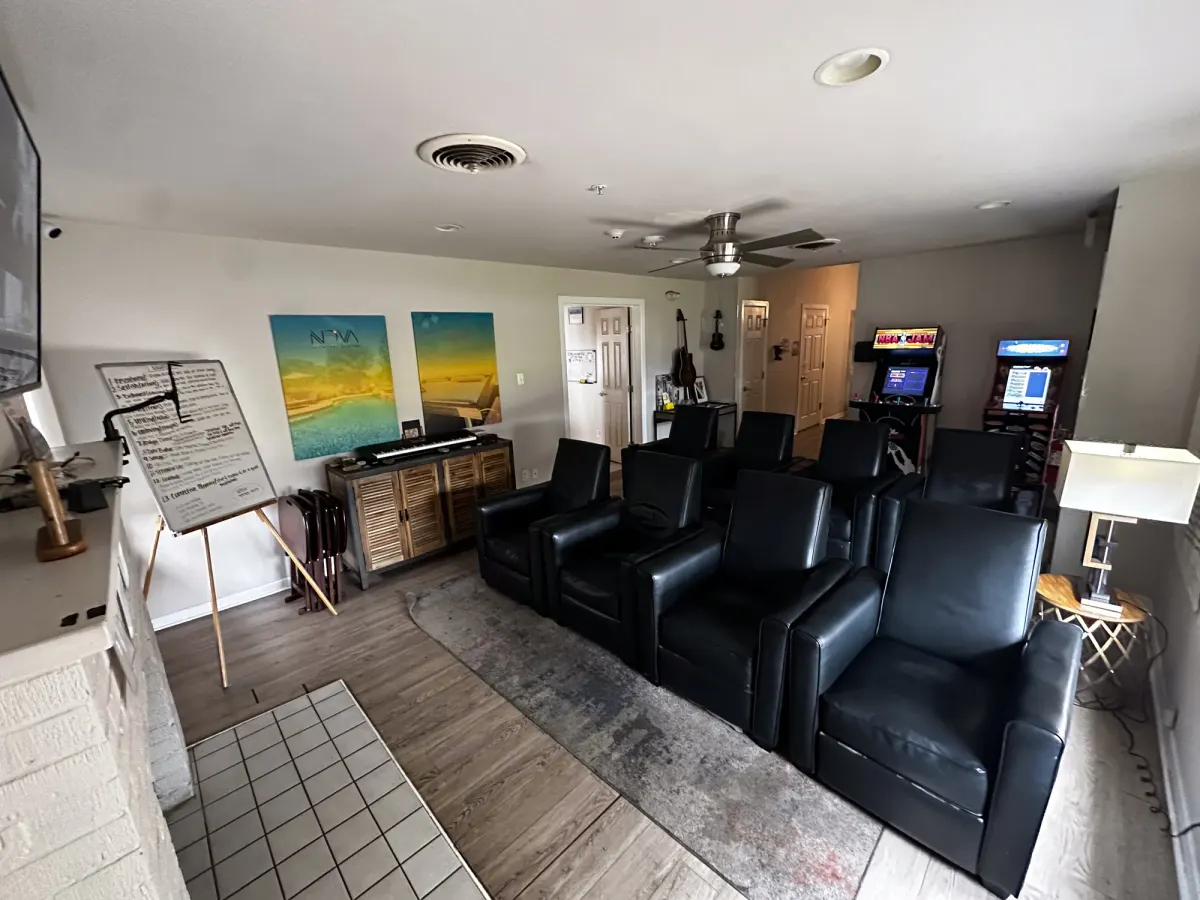 Inpatient
 Austin, TX
11711 N Lamar Blvd · 78753
- 15 beds
- On-site labs
- 24-hour medical staff
Drug & Alcohol Detox in Austin, TX
-
 Inpatient
 Houston, TX
1019 Ashland St · 77008
- On-site labs
- 24-hour medical staff
Drug Detox Center in Houston, TX
-
 Outpatient
 San Antonio, TX
6707 W Hausman Rd · 78249
- Outpatient detox with scheduled medical visits
- Outpatient treatment
Outpatient Drug & Alcohol Detox in San Antonio
Why can’t you sleep after quitting drinking?
Because alcohol was doing something to your sleep every night, and the brain takes weeks to stop expecting it.
The numbers are stark. In one study, 91% of inpatients scored above the clinical cutoff for poor sleep after one week of abstinence. Nearly three-quarters of 82 inpatients reported sleep problems immediately after detox. In 56 recently abstinent patients, insomnia symptoms persisted for about five weeks, and another study found sleep-quality scores still above the clinical cutoff at 12 weeks.
So if you are at day 30 and still sleeping badly, you are not behind. You are on schedule.
Source: Treatment options for sleep disturbances during alcohol recovery, National Library of Medicine.
What changes between week 2 and day 30?
Between week 2 and day 30 the physical symptoms are mostly gone and the psychological ones become the work.
Cravings arrive on a schedule that has nothing to do with the clock — a time of day, a place, a mood you used to drink at. Mood swings are common and usually mild. Concentration and energy improve unevenly, a good day followed by a flat one. None of this is a medical problem, and all of it is the reason the first month is when people quietly stop.
The one physical symptom that does persist is the sleep, above. It is worth knowing that on its own, because it is the symptom people most often decide to medicate with a drink.
Does poor sleep make relapse more likely?
Yes, measurably, and it is the single most useful thing to know at day 30.
In one study, 60% of patients who had insomnia in the six months before quitting had relapsed at five months, against 30% of those who had not. The review that reports it describes sleep continuity measures as robust predictors of relapse during recovery from alcohol dependence.
The mechanism is not mysterious. Alcohol knocks people out, so a return to drinking is rewarded with sleep, and the brain learns the lesson quickly. That is why treating the insomnia — rather than waiting it out — is a recovery intervention and not a comfort one.
What should happen after 30 days sober?
Thirty days is where a program ends and a plan has to start, and the two are not the same thing.
Thirty days is the standard length of an inpatient stay, which is why the number carries weight — it is a finish line for the program, not for the recovery. What the evidence above says is that at day 30 the sleep is still disrupted and the relapse risk is still live. So the useful question is not “am I done” but “what is the structure for the next 60 days”.
For most people that means stepping down rather than stepping off: intensive outpatient treatment keeps clinical contact several times a week while life resumes around it, and it is where the sleep and the cravings get worked on rather than endured. The what comes after detox page lays out the levels.
And if you are reading this at day 3 rather than day 30, medically supervised alcohol detox is what covers the window this page opened with. Admissions is answered around the clock, including at the hour you are most likely to be awake.
Common Questions
Is day 3 the worst day of alcohol withdrawal?+–
For most heavy daily drinkers, yes -- symptoms peak around 72 hours after the last drink. Feeling worse on day 3 than day 1 is the expected timeline. Confusion, hallucinations, a seizure, or fever with heavy sweating are the signs it has become an emergency.
How long does insomnia last after quitting alcohol?+–
Longer than people expect. Insomnia persisted for about five weeks in one study of recently abstinent patients, and sleep-quality scores remained above the clinical cutoff at 12 weeks in another. Still sleeping badly at day 30 is normal.
What happens to your body after 30 days without alcohol?+–
The acute withdrawal is long over, blood pressure and liver enzymes are typically improving, and appetite and energy are returning unevenly. Sleep is the system that lags, and cravings tied to habit and mood are usually still present.
Can I detox from alcohol at home if I made it to day 3?+–
Reaching day 3 does not mean the dangerous window has closed -- delirium tremens can appear up to 3 to 5 days after the last drink. If you drink heavily every day, the safer route is supervised detox, and the signs that make it urgent are confusion, hallucinations, a seizure, or fever.
Why do people relapse right after 30 days?+–
Because a program ending is often mistaken for recovery being complete, at a point when sleep is still disrupted and relapse risk is still elevated. Structured step-down care in the following weeks is what the evidence supports.
Related guides
About the people behind this guide
Anna-Grace Washington
Medical Content Writer
Anna-Grace Washington is a Medical Content Writer for Briarwood Detox Center. She holds a master’s degree in clinical psychology from the University of Texas and brings a strong understanding of behavioral health, addiction recovery, and evidence-based treatment concepts to her writing.
Dr. Robert Ulrich, DO
Medical Director
Dr. Robert Ulrich serves as Medical Director at Briarwood Detox Center, bringing more than two decades of clinical neurology experience to the treatment of substance use disorders. He is board-certified in neurology by the American Board of Psychiatry and Neurology and completed his neurology residency at UT Southwestern Medical Center in Dallas, where he served as Chief Resident.
In network with most major insurance
Find your plan and see what detox would cost
Most plans cover medical detox. Coverage varies by plan, so we verify it for you before you commit to anything.



















Don't see your plan? We work with out-of-network benefits and offer self-pay options — (866) 710-7710
- Confidential
- Takes about 2 minutes
- No obligation to admit

- Accredited The Joint Commission
- Rated 4.5 · 95 Google reviews
- Admissions 24 hours a day